

jagWARS
Jaguars, Raptors and the Patterns of War: 14th-18th century South American Indigenous sculptural arts
Home

Two clubs featuring ornate carved panels depicting serpent-like creatures. Courtesy, Ethnologisches Museum, Staatliche Museen zu Berlin. Left: L:42cm; W:8cm; D:4.9cm, DA 10422. Right: L:42cm; W:8.7cm; D:4.3cm, DA 10428.
At the cusp of European contact, north-eastern South America - what would later emerge as the countries of Venezuela, the Guyanas and northern Brazil - was the centre of some of the continent's richest iconography, captured in masterpieces of wood and stone sculpture. These include drug-related paraphernalia depicting jaguars and raptorial birds attributed to the 'Rio Trombetas' region and large, double-handed weapons with elaborate two-dimensional designs in wide circulation from the Guyanas north to the Lesser Antilles. These two unique carving traditions are tightly constrained by their form and iconography, making them excellent case studies for addressing the development, range and source of their individual styles. Examples of these carvings are widely dispersed, predominantly in European collections, and, as a result, have never been studied as a corpus. Some can be traced back to early 16-17th century collections, and likely reflect a style of carving contemporary with the first explorations of the 'New World,' if not earlier. If, taken at face value, the block-headed clubs are an overt expression of physical power, the Trombetas materials reflect the power of ritual, linking the user with the numinous through hallucinogen-inspired trance. Both inform on the myriad interrelated issues central to the escalating socio-cultural complexity in pre-/post-colonial South America.
The jagWARS project, supported by a Gerda Henkel Stiftung Research Grant, brings together more than 100 surviving carvings from over 30 international museums in a study of their material, chronology and iconography. In providing an overview of the dispersed corpus, the project is in a position to place this little-known artistic heritage within its cultural and historic context for the first time.
The resulting four main lines of evidence - stylistic, chronological, material and spatial - will be used as the framework to explore a further series of questions relating to the social context of these object classes. Linking them are notions of power - both physical (weapons) and spiritual (drug paraphernalia).

Sculpture
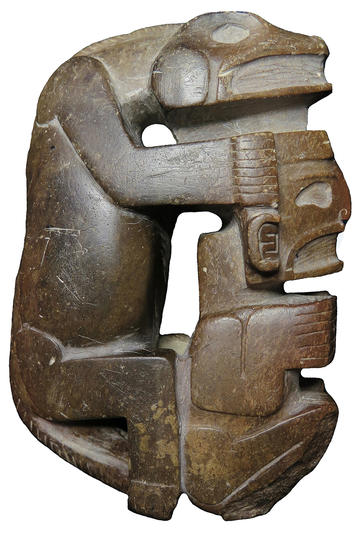
Ceremonial stone bowl in form of jaguar over human. H:18cm; W:6.5cm; D:12cm. Courtesy, Etnografiska Museet, National Museum of World Culture, Göteborg, 25.12.1.
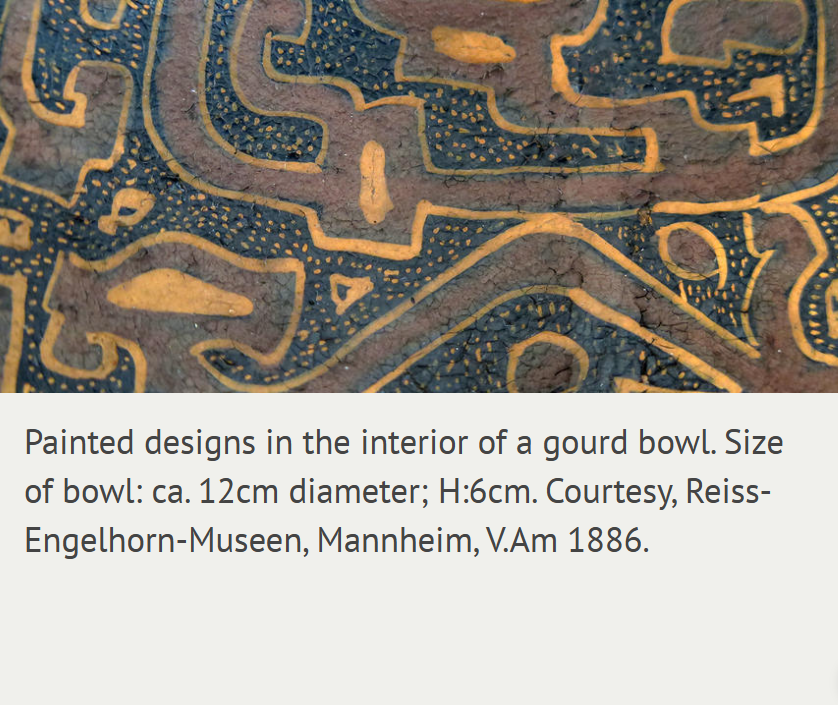
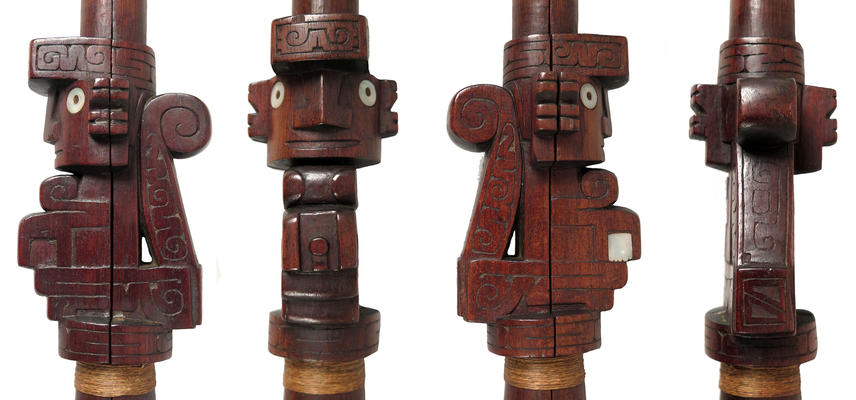
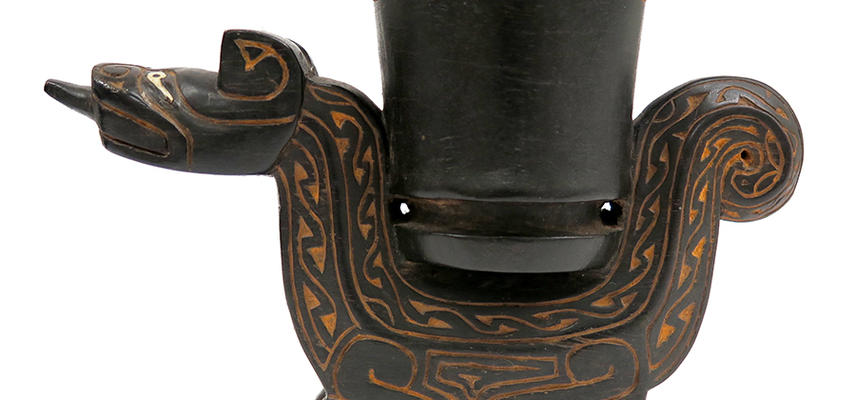
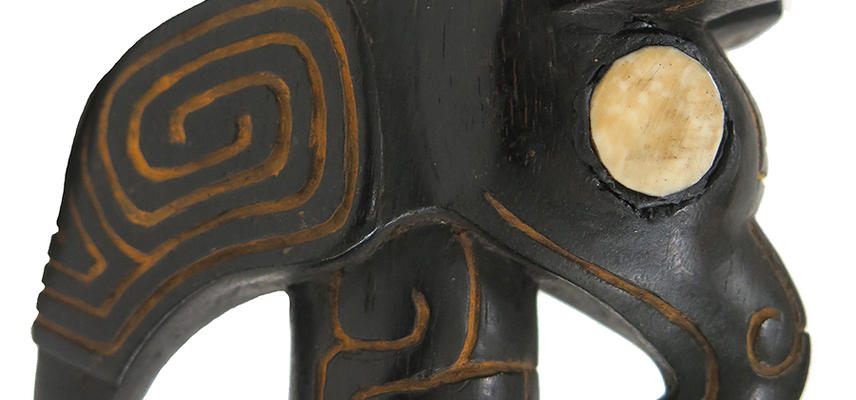
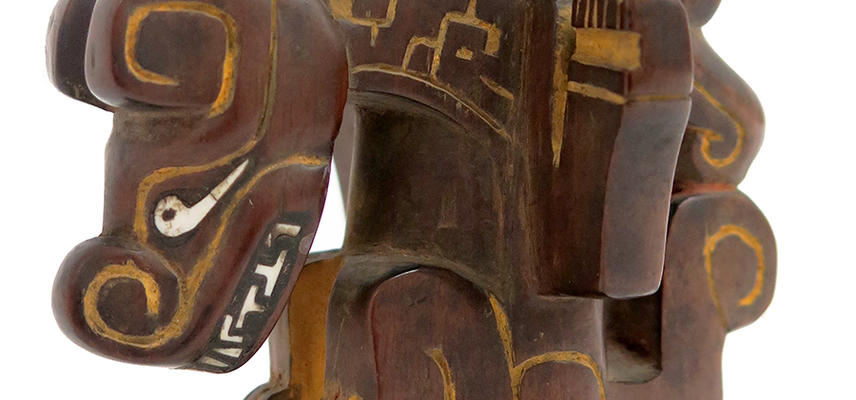
The ceremonial paraphernalia attributed to Brazil's Rio Trombetas region - including elaborate rattles, trumpets, mortars, containers and snuff tubes - typically combines animal/human imagery ('alter-egos'), 'comma-shaped' eye inlays, curved leg joints and rectilinear two-dimensional design panels (which are loosely parallelled in designs on the double-handed clubs). The select iconography includes jaguars and raptors which have a deeply embedded potency in the region - as significant players in origin myths and, given their predatory nature, epitomise virility and prowess. They also feature anthropo/zoomorphic transformative iconography, of creatures merging and morphing into each other. These are carefully made according to recognised stylistic conventions, carved from dark, dense woods and inlaid with white shell for enhanced contrast: while small in scale they have monumental impact. They are not simple, personal items made for private use, but made to be seen, as integral parts of community ceremonies, reflecting the power of ritual and linking the user with the numinous through hallucinogen-inspired trance.
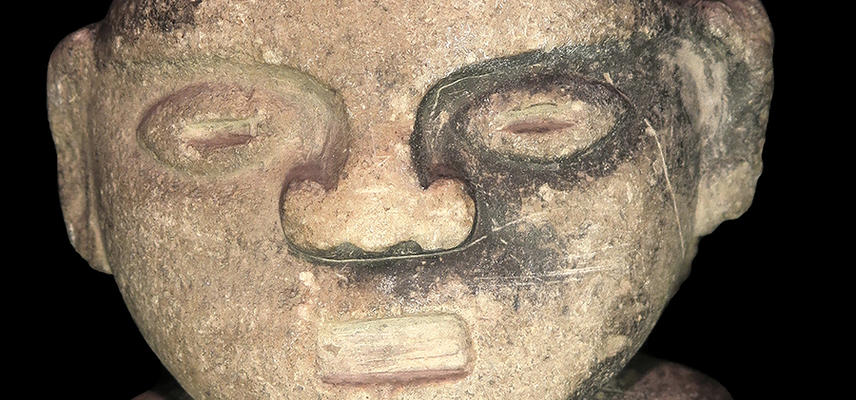
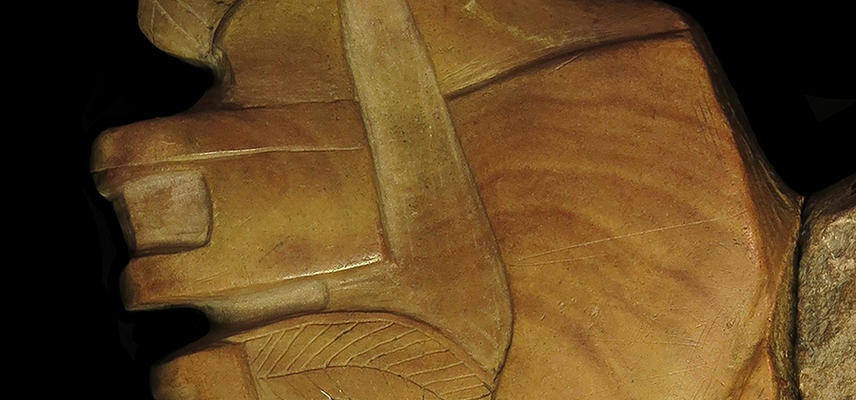
A study of these artefacts can provide a chronological context to the stylistically similar stone carvings (left) that mark for many the apogee of the region's artistry, but lack any associated histories, having been found outside of archaeological contexts.



Weapons
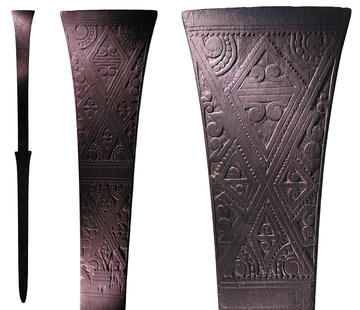
Club recovered from the San Pedro shipwreck of 1596. L:149cm; W:12.5cm; D:2.3cm. Tucker Collection, 79:155.211. Courtesy, National Museum of Bermuda.
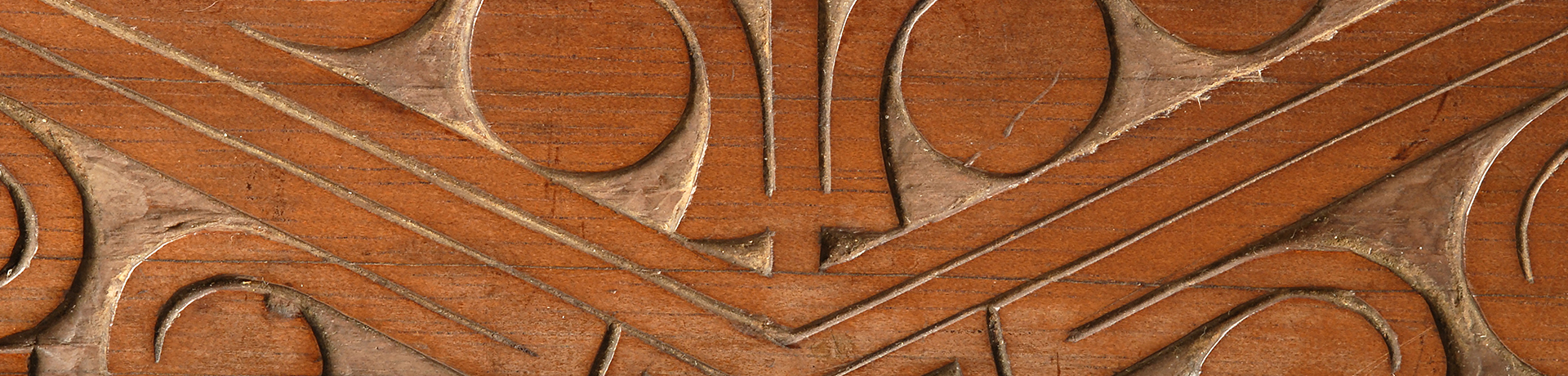
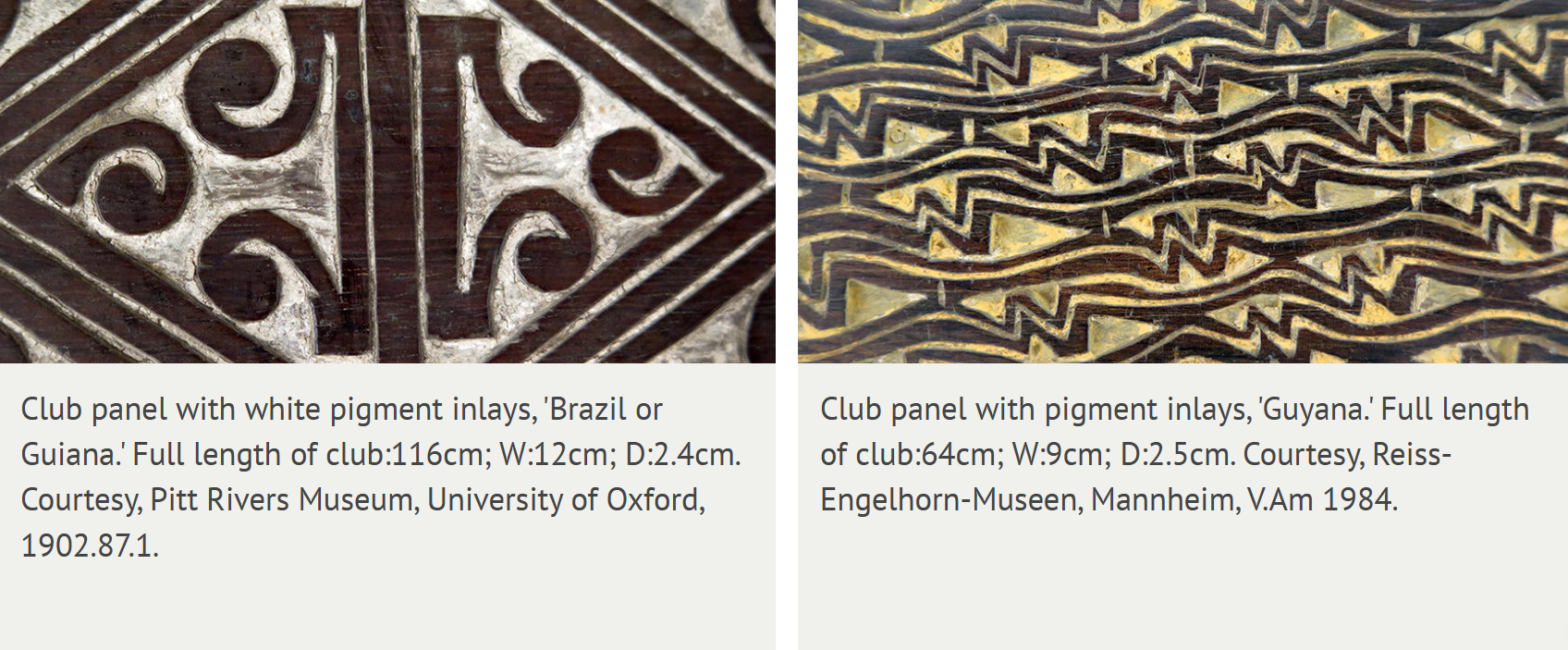
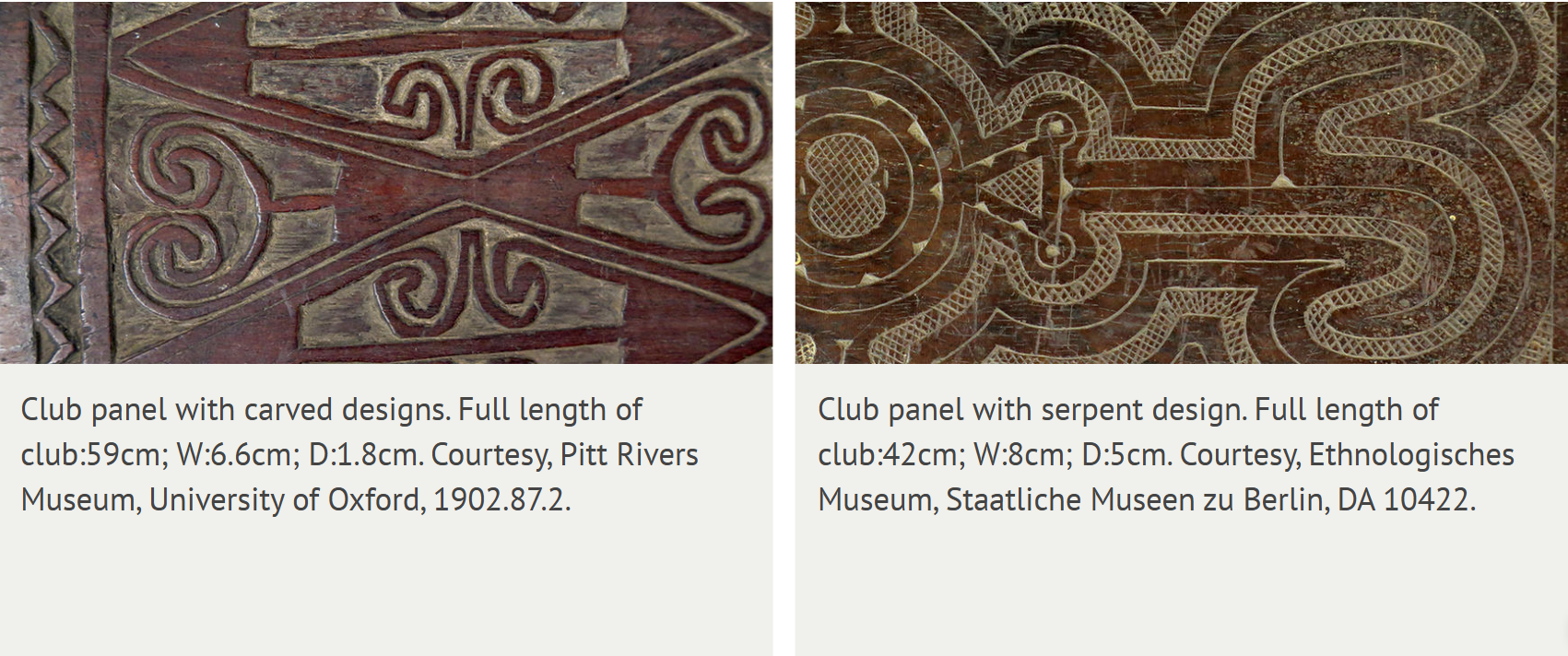
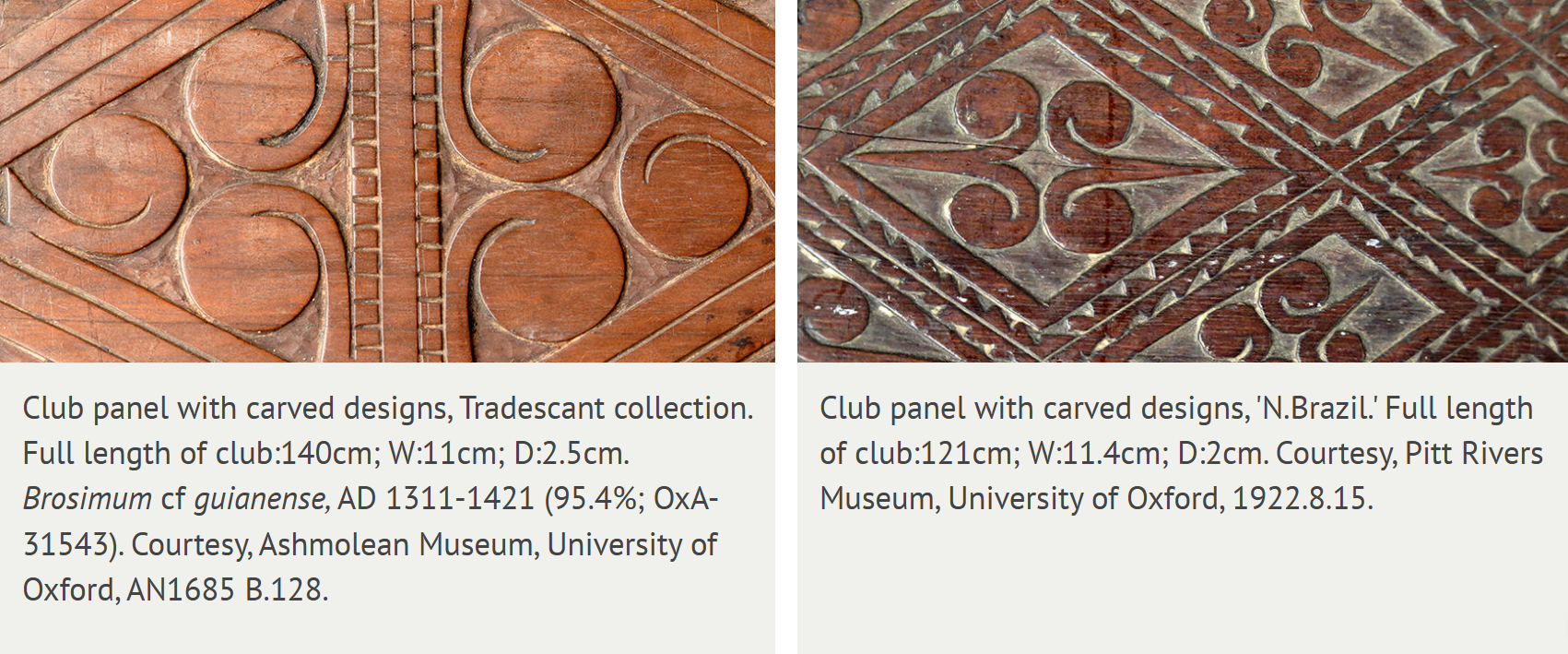
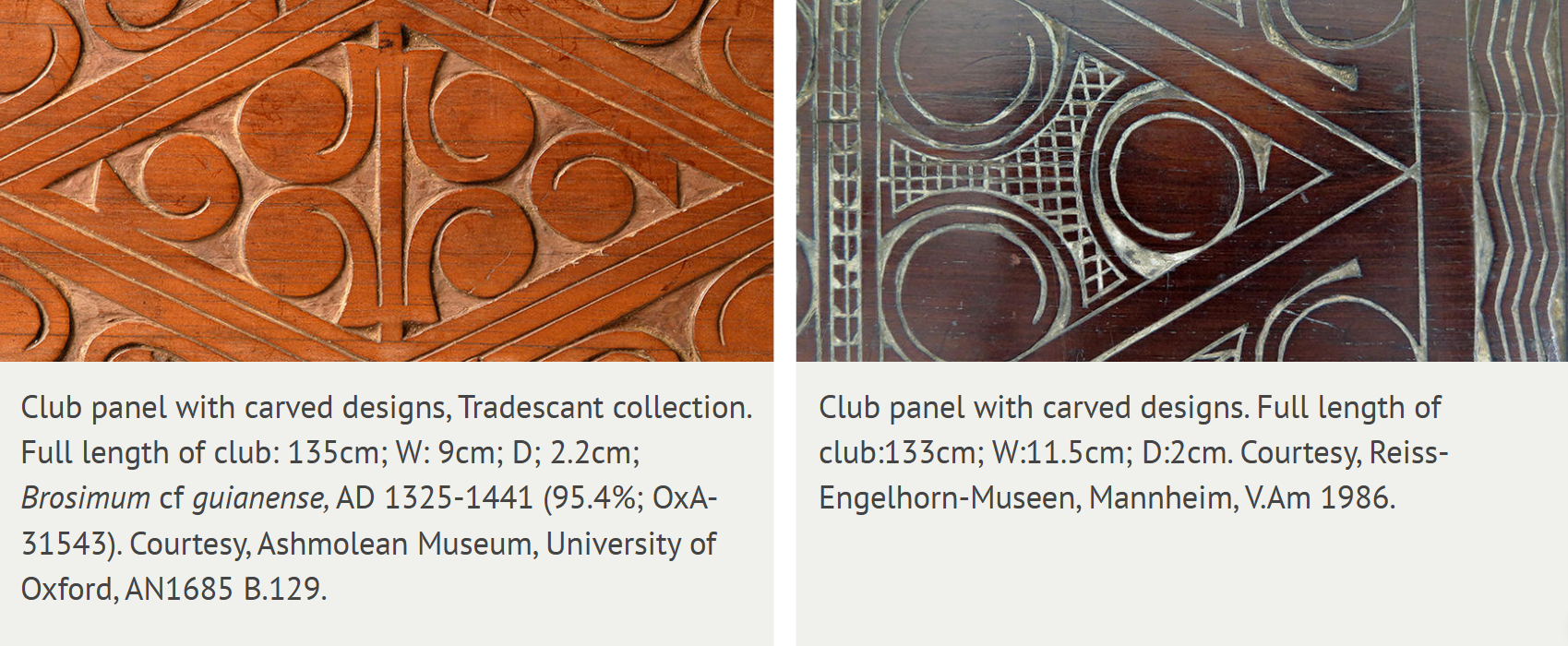
Boutou are large, double-handed clubs, carved of tropical hardwoods and embellished with curvilinear and geometric two-dimensional designs on the broad faces of their terminal ends. Some of these designs are unique, but many show strong stylistic affinities that suggest a regional style or perhaps even the work of individual artists.
These clubs were documented as far north as the Lesser Antilles, and are frequently depicted in the hands of the Kalinago (Island Carib) warriors in 16th-17th century illustrations. As weapons from newly found lands, these clubs took particlar pride of place in curiosity cabinets and early museums in Europe. But they were not simply weapons; like the drug paraphernalia studied as part of jagWARS, boutous were also ritual items in their own right, elaborated beyond their intended purpose to become insignia of rank, status and power.
There are roughly 40 examples of the long variety of club (over 1 meter in length) in early museum collections, and many more smaller examples (averaging ca. 50cm) that appear to be later in date. jagWARS will document the wide iconographic range of club styles, to explore whether it is possible to distinguish chronological placement stylistically.
Meet the Team
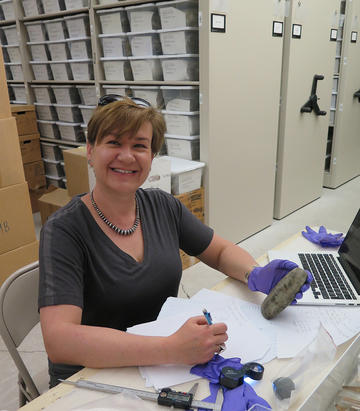
Joanna Ostapkowicz is principal investigator on jagWARS, and Research Associate in Caribbean Archaeology at the School of Archaeology, University of Oxford. Her research focuses on bringing a wide span of analytical techniques to better understand the chronological range, materials and provenance of circum-Caribbean artefacts in museum collections. She has been principal investigator on several international, multidisciplinary research projects that bridge the arts and sciences, including Pre-Hispanic Caribbean Sculptural Arts in Wood (funded by the Getty Foundation and British Academy), Black Pitch, Carved Histories: Prehistoric wood sculpture from Trinidad's Pitch Lake (Arts and Humanities Research Council [AHRC], UK) and SIBA: Stone Interchanges in the Bahama Archipelago (AHRC; https://siba.web.ox.ac.uk)
It has been her long term goal to study the remarkable collections that are at the core of jagWARS.
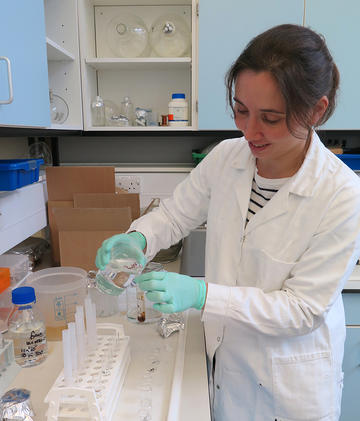
Fiona Brock is Reader in Analytical and Archaeological Science at Cranfield Forensic Institute, where her research focuses on the identification and preservation of organic materials in the archaeological record. As part of jagWARS, she will be advising on 14C dating strategies (especially for samples with unknown conservation histories) and identification of resins and pigments.

Christophe Snoeck is Professor in the Analytical, Environmental and Geo-Chemistry Research Unit, Department of Chemistry, Vrije Universiteit Brussel. He specialises in isotope analyses of archaeological remains and artefacts. Within the jagWARS project, he will carry out strontium isotope analyses of the different artefacts to identify their geographical origin. Particular care will be taken to minimalize sample size and remove conservation agents that might have been applied to the artefacts.
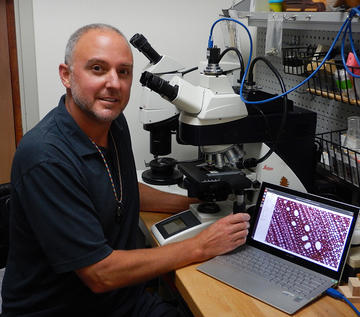
Alex C. Wiedenhoeft is a Research Botanist and Team Leader in the USDA Forest Products Laboratory’s Center for Wood Anatomy Research. His research program emphasizes botanical wood anatomy, forensic wood science, and biocentric wood science. He holds academic positions at the University of Wisconsin- Madison, Purdue University, Sao Paulo State University- Botucatu, and Mississippi State University. He is an elected Fellow of the International Academy of Wood Science, a Deputy Executive Secretary of the International Association of Wood Anatomists, and an Associate Editor for the IAWA Journal. Within the jagWARS project he will conduct forensic identification of the woods used in the artefacts and seek to understand the material knowledge implicit in those wood choices.

