
GRAMADIF
Small scale cultivation in the Qara Dagh (northern Iraq)
Fundings
In the framework of the Horizon Europe, the GRAMADIF project was awarded a Marie Skłodowska-Curie Individual Fellowship for a duration of 24 months. The research is carried out at the Institute of Archaeology, University of Oxford, in collaboration with iraqi authorities and excavation teams.
During the 4th-3rd millennia B.C in Mesopotamia, communities previously living in small egalitarian villages progressively grew into large cities, ruled by political, religious and economic institutions. Cultural expansions and climate change contributed to socioeconomic transformations and adaptations including in crop production. The development of an intensive irrigated farming system in southern Mesopotamia enabled the rise of early cities there; simultaneously, in rain-fed northern Mesopotamia, an extensive, low-input farming system supported early cities. But while agriculture appears to be one of the main drivers behind the emergence and development of the first Near Eastern cities, the evidence mostly consists of indirect sources such as 3rd and 2nd mill. BC cuneiform texts. The study of charred macrobotanical remains (seeds, fruits, chaff) recovered from newly excavated archaeological sites, located in northern and southern Mesopotamia, offers a unique opportunity to reconstruct the evolution and regional variability of plant production between the 7th and the 1st mill. BC. This project will study the role and the impact of the development of agriculture in the emergence of the urban centres.
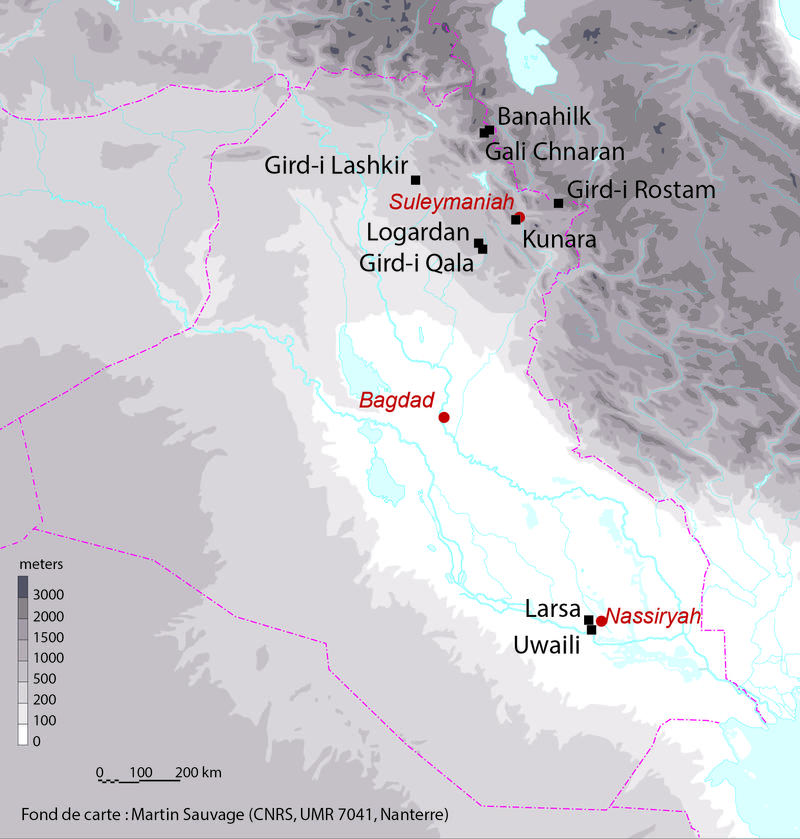
Map showing the archaeological sites where the material of the GRAMADIF project is coming from.
Northern Iraq:
- Gird-i Bana Hilk (2018-now)
Dir.: Dr. Anna Gómez Bach (Universidad Autonoma de Barcelona, SAPPO) in collaboration with the Department of Antiquities of the Soran region.
- Girdi-i Lashkir (2015-now)
Dir.: Prof. Miquel Molist (Universidad Autonoma de Barcelona, SAPPO) in collaboration with the Erbil Civilization Museum and the University of Salahaddin.
- Gird-i Qala & Logardan (2015-now)
Dir.: Dr. Régis Vallet (CNRS, ArScan) and since 2020: Dr. Johnny Baldi (CNRS, Archéorient) in collaboration with the Department of Antiquities of Suleymaniah.
- Gird-i Rostam (2019-now)
Dir.: Prof. Karen Radner (Ludwig-Maximilians-Universität München) and Prof. Daniel Potts (New-York University, ISAW)
- Kunara (2012-now)
Dir.: Christine Kepinski (CNRS) and then Dr. Aline Tenu (CNRS, ArScan-HAROC) in collaboration with the Department of Antiquities of Suleymaniah.
Southern Iraq:
- Tell el-'Uwaili & Larsa (2019-now)
Dir.: Dr. Régis Vallet (CNRS, ArScan) in collaboration with the Department of Antiquities of Nasiryiah.
On the field
The first step of the project is to create an archaeobotanical dataset in parallel with the ongoing archaeological projects. Since 2018 we are involved in several excavations in Iraq. We collect soil samples and process them using a mechanical flottation (and in some cases a manual system) to recover the macrobotanical remains. During field seasons we are assisted by local workers and students. We constantly interact with other archaeologists and specialists to ensure that our scientific aims meet the project research questions and vice versa.
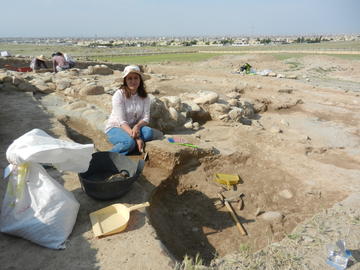
S. Halko Fatah collecting bulk of soil on the site of Gird-i Lashkir (Erbil governorate)
In the lab
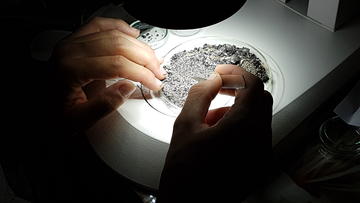
The second step is to analyse the archaeological assemblages in order to provide a list of taxa present in the natural environment of the site and/or exploited by the inhabitants. We use a low-power microscope to sort the light residues exported with the permission of the iraqi authorities. To identify the floral parts and the taxa we compare the archaeological specimens to atlases and the reference collection (herbarium) of the Institute of Archaeology of Oxford. We also use regional floras, mostly the Flora of Iraq and the Flora of Lowland Iraq. The main aim of the project is to determine the major crops exploited on the different settlements, according to their occupation period and geographical location.