
OCMA

The Oxford Centre for Maritime Archaeology (OCMA) is a specialist research project within the School of Archaeology supported by the Hilti Foundation. It is devoted to the study of people who live or work on and around water.
The OCMA offers undergraduate and postgraduate options in maritime archaeology; post-graduate research ranges from the Mediterranean and its surrounding seas and oceans to the maritime cultures and peoples of the Indian Ocean and the South China Sea from antiquity to the early modern period.

The Centre currently partners a number of fieldwork projects. In Egypt, the OCMA collaborates on projects implemented by the Institut Européen d’Archéologie Sous-Marine (IEASM), under the direction of Franck Goddio, supported by the Hilti Foundation.

The OCMA also promotes research through a vigorous programme of international conferences that bring together specialists in maritime cultures, as well as outreach events aimed at a more general audience. The Centre’s peer-reviewed monograph series is published in-house and distributed by Oxbow Books. The series includes excavation reports, specialist object analyses, and edited thematic volumes based upon OCMA conferences.


The shipwreck J3 was discovered by the IEASM in the Eastern harbour of Alexandria (Portus Magnus) in 2017 and completely excavated the next year. This was a small Roman boat some 6 m long that was well preserved in the sandy sediments at the depth of about eight metres. The port side of the ship was preserved completely, including two thwarts, a guard rail and three thole pins. The ship was flat-bottomed and had a keel. The surviving keel of shipwreck J3 was 4.4 m long while its stem was missing. The keel was rectangular in section and had no rabbet. In the middle of the hull, six lines of strakes were preserved on the starboard of shipwreck J3 and fourteen strakes on the port. The construction of the boat demonstrates a well-developed internal structure with 21 frames preserved. The carvel planking of the ship was assembled with mortise-and-tenon joints cut in the middle of the planks’ edges. The boat had a mast as evidenced by a mast-step and remains of the rigging. A wide choice of wood species was used in the construction. Transom aft, dating, and the size of the ship allows considering it as the horeia-type of a boat which is known both from iconography and the shipwrecks from Toulon and Napoli. Like those, the ship dates to the first century AD as per the ceramic assemblage in context. The interesting aspect of the ship is that it was transporting a large iron anchor the moment it sank. The anchor occupied almost the entire preserved length of the ship and it was carefully positioned on the decked aft area and under the removable thwarts. The small size of the wreck allowed completely excavating it in one season and to perform numerous sections to reveal the details of its internal construction. The shipwreck brings more information on the construction of the horeia-type boats and their implementation in the activities of the Portus Magnus of Alexandria.
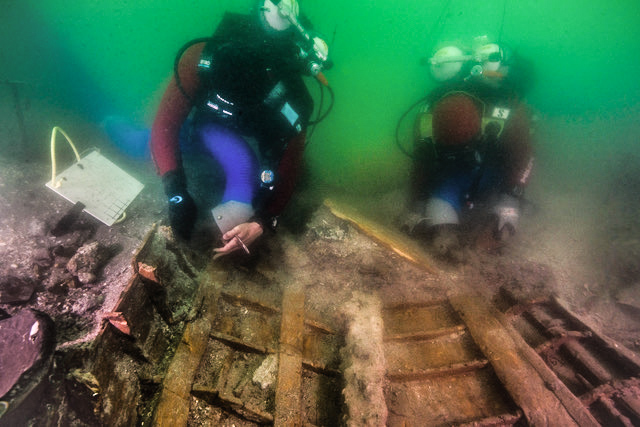
Christoph Gerigk © Franck Goddio/Hilti Foundation
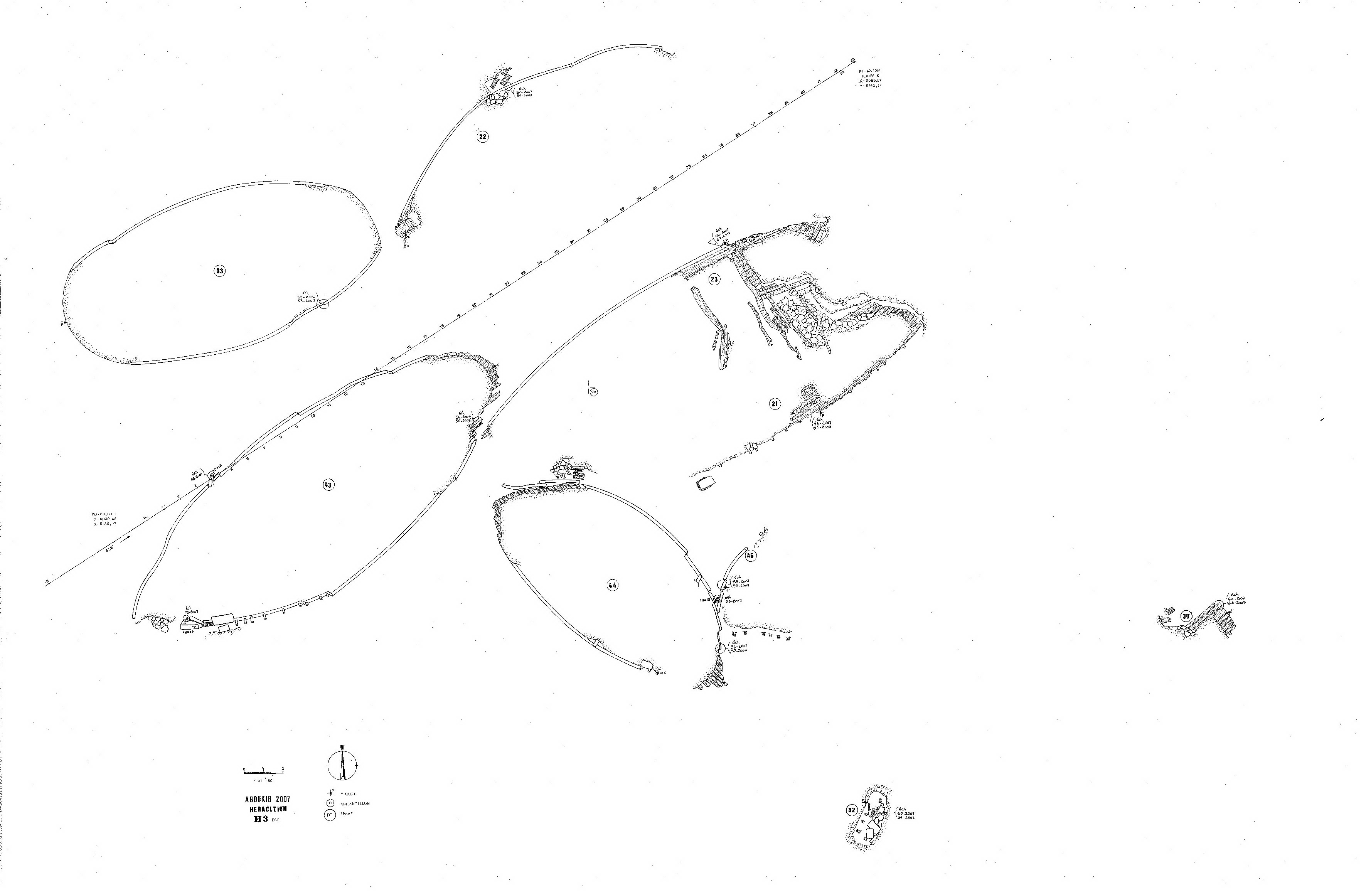
In 2011, a team from the Oxford Centre for Maritime Archaeology and the National Museum of the Philippines, supported by the IEASM during their annual mission to Aboukir Bay, began to excavate shipwreck 43, a vessel found in the northern section of the Central Harbour of Thonis-Heracleion. The wreck is one of at least 64 ancient shipwrecks discovered during Franck Goddio’s on-going survey and excavations at the port-city. Upon discovery in 2007, the upper layers of sand around the surviving edges of the wreck had been removed by a team from the IEASM from the surviving edges of shipwreck 43 and the outline mapped. Wood samples were also taken for wood species analysis and radiocarbon dating. Subsequent analyses demonstrates that the structural elements of the wreck were found to be made from locally-available Acacia totilis/radiana, suggesting that the vessel was Egyptian in origin The ship is tentatively dated between 785 and 481 cal. BC.
During the 2011 excavation season, the OCMA team aimed to investigate the wreck through limited stratigraphic excavation in order to understand the sequence of deposition, to assess the state of preservation of the shipwreck, and to document any remaining structural elements. From our preliminary excavations at the stern of the vessel, it would appear that it has a distinctive form of naval architecture involving the use of long tenons that were initially fitted to mortise holes that passed through the keel plank, over which multiple lines of planking were added. These were pegged into place with wooden treenails.
From the albeit limited excavations, there do not appear to be any frames and consequently the long tenons may have provided the structural stability of the vessel through a kind of ‘internal framework’. This probably reflects a shipbuilding tradition that developed in accordance with the availability of local supplies of timber and the realities of nautical life at the margins of the Nile Delta.
The excavations also revealed something of the life of the ship following its withdrawal from service and it appears that the vessel was reused in antiquity for a purpose that is, at present, enigmatic. Hypotheses under consideration include the use of the vessel as part of a type of ‘pontoon bridge’ and the deliberate fastening in position for defence or land-reclamation purposes. A stone anchor, found complete with its wooden flukes, was recovered adjacent to the stem plank.
This work is supported by grants from the Honor Frost Foundation.
Publications
2015. Robinson, D. and Goddio, F. ‘Ship 43 and the graveyard in Thonis-Heracleion’, in D. Robinson and F. Goddio (eds), Thonis-Heracleion in Context. Oxford Centre for Maritime Archaeology Monograph 8: 211–25. Oxford: OCMA.
2011. Fabre, D. ‘The Shipwrecks of Heracleion-Thonis: A Preliminary Study’, in D. Robinson and A. Wilson (eds) Maritime Archaeology and Ancient Trade in the Mediterranean. Oxford Centre for Maritime Archaeology Monograph 6: 13–32. Oxford: OCMA
http://honorfrostfoundation.org/index.php/dr-damian-robinson-ship-43-from-heracleion-thonis/
http://honorfrostfoundation.org/wp/wp-content/uploads/2015/04/Robins on-HFF-report-Ship-43-2014.pdf
P. Sandrin © Franck Goddio/Hilti Foundation
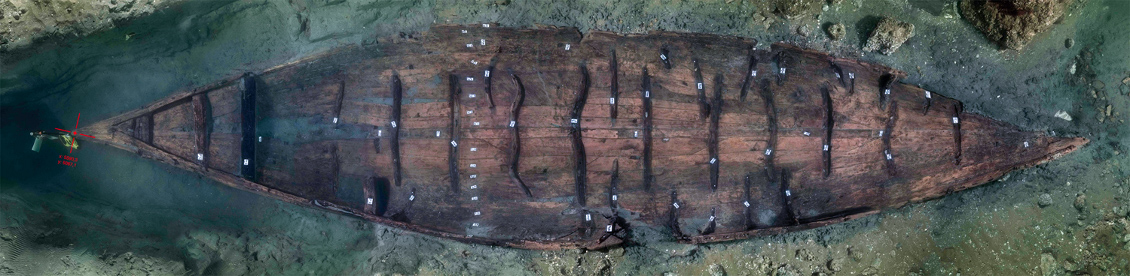
At the western end of a major waterway in the port-city of Thonis-Heracleion, Egypt, the l’Institut Européen d’Archéologie Sous-Marine (IEASM) discovered a small boat. Excavated in 2010, it is currently being prepared for publication at the Oxford Centre for Maritime Archaeology (OCMA), with the nautical architecture being analysed by Carlos Cabrera Tejedor. The vessel has a crescentic shape with a flat-bottomed hull that was constructed from Sycamore Fig planking. This was assembled using mortise-and-tenon joinery with frames secured to the planking using double-clenched copper alloy nails. Preliminary analyses of the vessel form, context of its deposition, and the objects discovered around it, suggest that ship 11 may be the remains of a sacred barque associated with the god Osiris. The vessel had seen a lifetime of work in and around the waterways of the port-city as here, as elsewhere in Egypt, the boat was at the functional heart of religious festivals and activities that were adapted to the local environment. Ship 11 was carefully abandoned at a propitious liminal location within the sacred geography of the city, articulated with the temples, shrines and waterways, and surrounded by a range of objects clearly placed into the water as part of acts of temple and everyday ritual.
Some preliminary discussion of ship 11 can be found in:
Robinson, D. 2018 ‘The depositional contexts of the ships from Thonis-Heracleion, Egypt’ International Journal of Nautical Archaeology 47(2): 325–36. https://doi.org/10.1111/1095-9270.12321
Goddio, F., 2015 ‘The sacred topography of Thonis‐Heracleion’, in D. Robinson and F. Goddio (eds), Thonis‐Heracleion in Context: 15–54. Oxford.
Goddio, F. and Fabre, D., 2015 Egypt's Sunken Mysteries. Paris.
Christoph Gerigk © Franck Goddio/Hilti Foundation
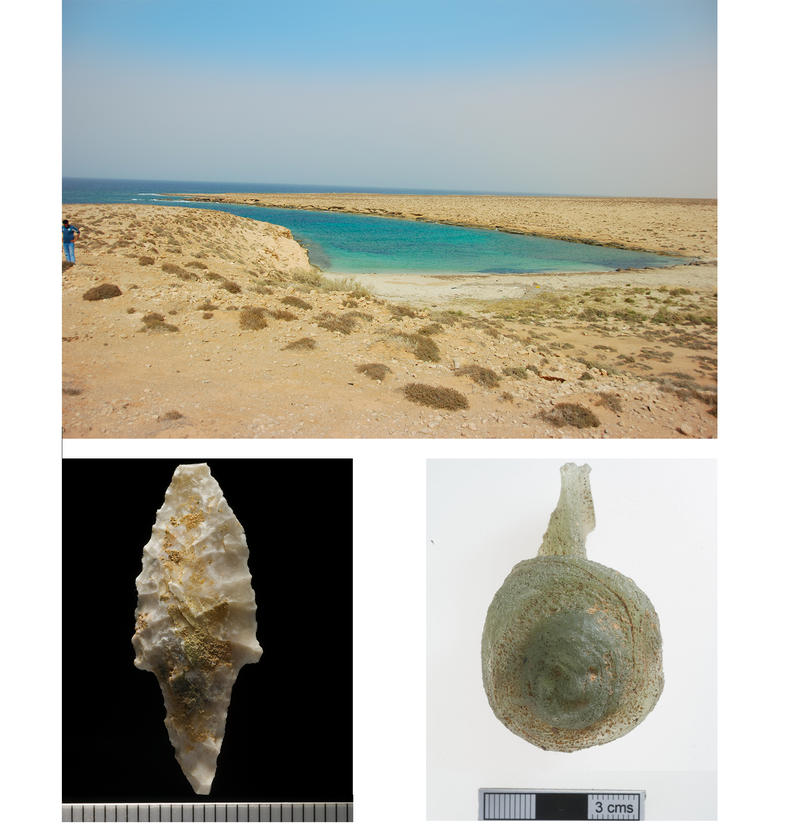
The Western Marmarica Coastal Survey (2008–2010) covered a region between Mara Lukk and Kambut, east of Tobruk in Libya. This area was viewed as a marginal area, an area to be passed through on the way to the major centres of Cyrenaica and the Egyptian delta. However, semi-arid areas such as these are sensitive indicators of the economic and political health of the state, from the Ptolemaic through the Late Antique periods: where governance is strong, then military and economic infrastructures will be present; where it is weak, they will decline. In the Late Roman period, agricultural produce was transported in locally-made amphora, some of Egyptian type, and in return a wide range of eastern Mediterranean fine wares, glass, and even fragments of Egyptian granite, porphyry and cippolino marble were acquired. The survey identified a progression from settlements oriented towards the sea in the earliest period to a more complex hierarchy of settlements linked connected by road as well as by sea.This depended upon good relations between nomadic and settled groups. In addition, the survey recovered evidence of early activity in the region, from the Middle Stone Age and particular the Libyco-Capsian and Neolithic periods. Nomadic activity is visible in a range of burials, the presence of Libyan Desert ware and knapped glass and rock art.
The final publication is in preparation.
Publications
2010. Hulin, L., Timby, J., Muftah, A.M. and Mutri, G. ‘Western Marmarica Coastal Survey 2010: preliminary report’, Libyan Studies 41: 155–62.
2009. Hulin, L. ‘Western Marmarica Coastal Survey 2009: preliminary report’, Libyan Studies 40: 95–103.
2008. Hulin, L. ‘Western Marmarica Coastal Survey 2008: a preliminary report’, Libyan Studies 39: 299–314.
2008. Hulin, L. ‘Western Marmarica Coastal Survey 2008’, PAST 60 (November).
© Linda Hulin; object photos © Ian Cartwright, School of Archaeology
Making maritime memories: the Country house and the Sea

Ship 17 a baris from Thonis-Heracleion
Theological Defences of the Canopic Gate in the Saïte Period
Thonis-Heracleion in Context
The Decree of Saïs
Maritime Archaeology and Ancient Trade in the Mediterranean

Alexandria and the North-Western Delta
La stèle de Ptolémée VIII Évergète II à Héracléion

The Naos of the Decades
Geoarchaeology

Topography & Excavation of Heracleion-Thonis & East Canopus
Continuity and Change from Ptolemaic to Roman Alexandria
(OCMA Symposium 8)
25th-27th September 2025, Harris Manchester College, Oxford
Further information about the conference will be posted at
Religious Landscapes of Egypt 16–18 February 2017. Museum Rietberg/University of Zurich
Far-reaching changes were happening in the religious life of Egypt during the latter part of its ancient history. From over the ‘Sea of the Greeks’ came foreign peoples, both as settlers and conquerors, bringing from their homelands their own gods and ritual practices. The meetings between Egyptians and incomers ushered in a dynamic period of accommodation and creative (mis)understanding as communities sought to negotiate their place within the new social and religious world or to stand apart from it. This conference investigated how these various processes played out across Egypt’s religious landscapes in texts, buildings and material culture. Papers examined how change happened and the extent to which it diverged from traditional Egyptian practices through an investigation of religious thought and performance, from the construction of temples to the deposition of objects. They confronted the spectrum of developing responses in the cities and towns of Egypt from the early parallel lives of Egyptians and Greeks at Thonis-Heracleion to the later synchronicity of the god Serapis and the construction of temples to venerate divine Roman emperors and celebrate the Imperial Cult. Finally, it assessed the coming of Christianity and the sweeping away of the former pagan religious landscape.

Heracleion in Context: The maritime economy of the Egyptian Late Period 15–17 March 2013. The Queens College, Oxford
The purpose of the symposium was to explore the maritime trading economy of the Egyptian port of Heracleion during the Late Period and to place it within the wider context of maritime trade at this time. Heracleion was the gateway to Egypt, the obligatory port of entry and customs point, and a vital node in the trading network of the eastern Mediterranean through which goods flowed into and out of Egypt. The port and its harbour basins contain a remarkable collection of evidence for the maritime trading economy, including customs decrees, trading weights, coin production as well as the remains of sixty-four ancient shipwrecks. These are set within a detailed understanding of the topography of the port-city, which has been investigated by European Institute for Underwater Archaeology under the overall direction of Franck Goddio. The symposium will present the latest work of scholars working on the excavation and post-excavation of Heracleion and will contextualise this through a series of wider ranging studies that examine the developing role of the port within the wider maritime trading economies of the Egyptian Late Period.
From over the ‘Sea of the Greeks’ came foreign peoples, both as settlers and conquerors, bringing from their homelands their own gods and ritual practices. The meetings between Egyptians and incomers ushered in a dynamic period of accommodation and creative (mis)understanding as communities sought to negotiate their place within the new social and religious world or to stand apart from it. This conference investigated how these various processes played out across Egypt’s religious landscapes in texts, buildings and material culture. Papers examined how change happened and the extent to which it diverged from traditional Egyptian practices through an investigation of religious thought and performance, from the construction of temples to the deposition of objects. They confronted the spectrum of developing responses in the cities and towns of Egypt from the early parallel lives of Egyptians and Greeks at Thonis-Heracleion to the later synchronicity of the god Serapis and the construction of temples to venerate divine Roman emperors and celebrate the Imperial Cult. Finally, it assessed the coming of Christianity and the sweeping away of the former pagan religious landscape.
The conference contents can be viewed here.
The Indo-Pacific World Special Seminar 28 November 2012. Institute of Archaeology, Oxford
From Madagascar to Rapa Nui, the Indo-Pacific world has been marked by great maritime achievements. This half-day seminar explored the maritime ethnography, archaeology, and history of this region through the work of three leading scholars: Dr Ian Glover, University College London (UK); Dr Pierre-Yves Manguin, École Française d’Extrême-Orient (France); and Dr Miguel Luque Talavan, University Complutense (Spain).
Cleopatra and the end of the Hellenistic world 29-30 September 2010. The Franklin Institute and the University of Pennsylvania Museum of Archaeology and Anthropology
This symposium was organised by the OCMA and the University of Pennsylvania Museum of Archaeology and Anthropology. Its purpose was to explore the extent to which the Hellenistic world of Cleopatra actually fell after the defeat at Actium. The conference addressed the issue of political endings and cultural continuity and investigated whether the demise of Cleopatra should be used as an allegory for the end of the Hellenistic world or whether this arbitrary modern separation of historical from cultural periods merely emphasises breaks where there may well have been continuity.
East meets West along the Maritime Silk Route 2-3 July 2009. Waseda University, Tokyo
This symposium, organised by the OCMA and the Institute of Egyptology, Waseda University, Tokyo, examined the trading dynamics of the maritime silk route from the Hellenistic period in the West until just prior to the rise of the Mongol empire in the East. Scholars from the fields of Classical, Byzantine, Indian and Asian maritime history and archaeology examined the longue durée of trade along the maritime silk route.
Maritime archaeology and ancient trade in the Mediterranean 18-20 September 2008. Universidad Carlos III, Madrid
This conference explored the contribution of maritime archaeology to the understanding of trade and exchange in the ancient Mediterranean. It marked the beginning of the international exhibition Sunken Treasures of Egypt, held at the same venue, that featured finds from the underwater excavations at Alexandria and Aboukir Bay by the Institut Européen d’Archéologie Sous-Marine (IEASM).
The trade and topography of Egypt’s North-West Delta: 8th century BC to 8th century AD 28-30 July 2006. Martin Gropius Bau, Berlin
This conference focused upon the trade, topography and material culture of Egypt’s North-West Delta over the period from the 8th century BC to the 8th century AD.
City and Harbour: the archaeology of ancient Alexandria 18-19 December 2004. St Hugh’s College, University of Oxford
This conference examined the contribution that recent archaeological work, both land-based and maritime, had made to our understanding of the city of Alexandria.

