The Practical Mariner
About the Project
The Practical Mariner Project explores the ancient sailing world in the Mediterranean from the perspective of mariners and their practical needs. We compare and contrast wayfaring and place-making on either side of the 3.2Ky climate event, i.e. 1500-800 BCE, during which rainfall declined sharply and state-run networks unravelled under pressure from a range of social and political factors, only to re-emerge in an altered and greatly extended form. Processes of wayfinding are of particular interest: did new routes emerge out of knowledge exchange with fishing communities or the persistence of low-level local and regional trade?
Our team is combining agent-based modelling software with geographical information systems to animate the complex interaction between the carrying capacity of the land, the organisation of coastal communities and the practical requirement of sea-borne living. We integrate the availability of food, water, chandlery, and materials for repairs on land with the presence of fish in the sea in different seasons and different points in the agricultural and maritime cycles. Our aim is to assess the impact of climate change on sailing and fishing networks, particularly along the north African coast and on smaller islands across the Mediterranean.
The Practical Mariner is a three-year research project at the School of Archaeology, University of Oxford. It is funded by the Augmentum Charitable Intitiative.

Making Landfall in the Ancient World
Linda Hulin
Principal Investigator
Linda Hulin’s interests centre upon interregional contact across the Mediterranean, but particularly in the east, in the Levant, Egypt, Cyprus and Libya. She focuses upon social relationships: how new information is learned and passes across time and space, and the interplay between aesthetic sensibilities and social identification in both the ancient and modern world.
Click here to view Linda's profile page
Karl Smith
PDRA in Maritime Archaeology Data
Karl Smith specialises in GIS, remote sensing, and computer modelling. His DPhil research focused on simulating prehistoric seafaring – specifically agent-based maritime mobility modelling, coastal visibility analysis, and methods of navigation. He has also worked as a geophysicist and GIS specialist on archaeological projects in the UK, Italy, Croatia, Greece, Oman, Turkmenistan, and Kazakhstan. His work with The Practical Mariner includes creating seafaring agent-based GIS models, using GIS data to model ancient ports and landing places, investigating the effects of resource/climatic variability on coastal communities, and supporting our fieldwork projects in the Mediterranean. Click here to view Karl's scripts on GitHub.
Max MacDonald
PDRA in Archaeology of the LBA Mediterranean
Max MacDonald completed his PhD at the Centre for Maritime Archaeology at the University of Southampton in 2024. His thesis focused on the human relationship with the sea in Late Bronze Age Greece. Drawing on his experiences growing up on the west coast of British Columbia, his research explored both maritime material culture and the emotional experience of the sea. He has participated in archaeological excavations in Greece, Italy, Spain, England, and Scotland, both underwater and on land.
Conferences
Come hang out with us and hear about our latest work!

Identifying Coastal Nodes in the Mediterranean
Session / Paper, The 53rd Annual Computer Applications in Archaeology Conference (CAA)
Vienna, Austria: March 31-April 4, 2026

Large-scale GIS coastal analysis and harbour 'affordance': a Sicilian/Cypriot comparison
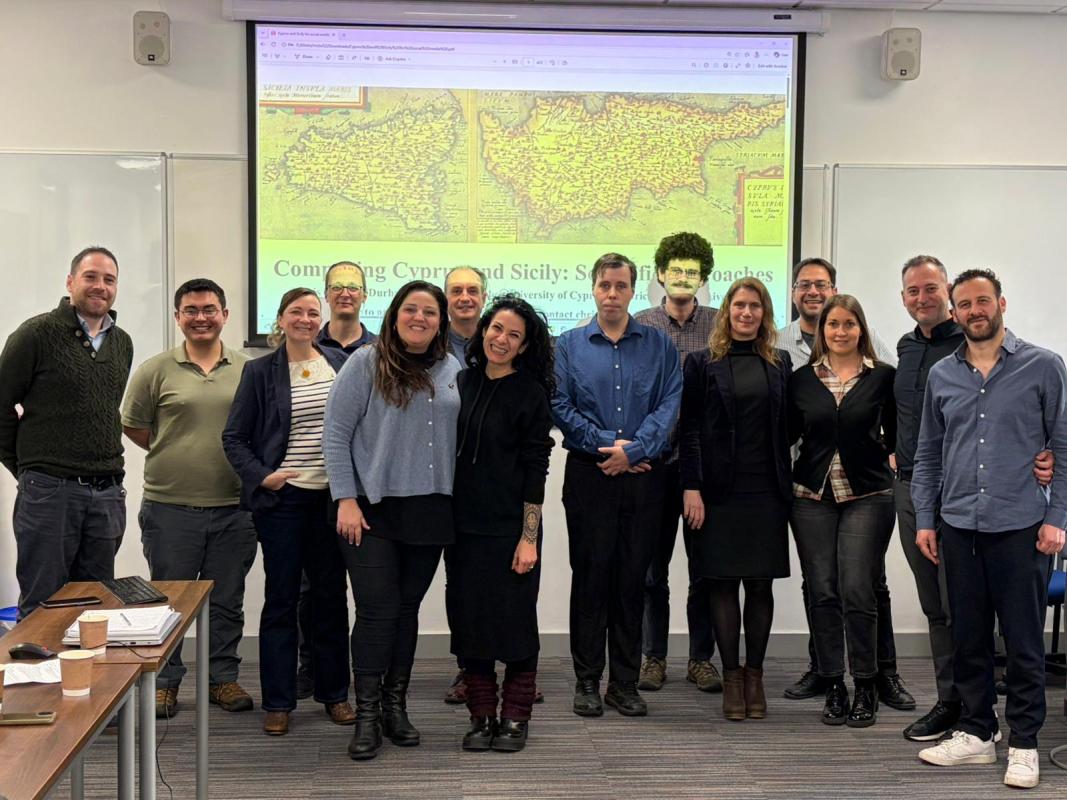
Paper, Comparing Cyprus & Sicily: Scientific approaches
Durham, UK: March 27-27, 2026

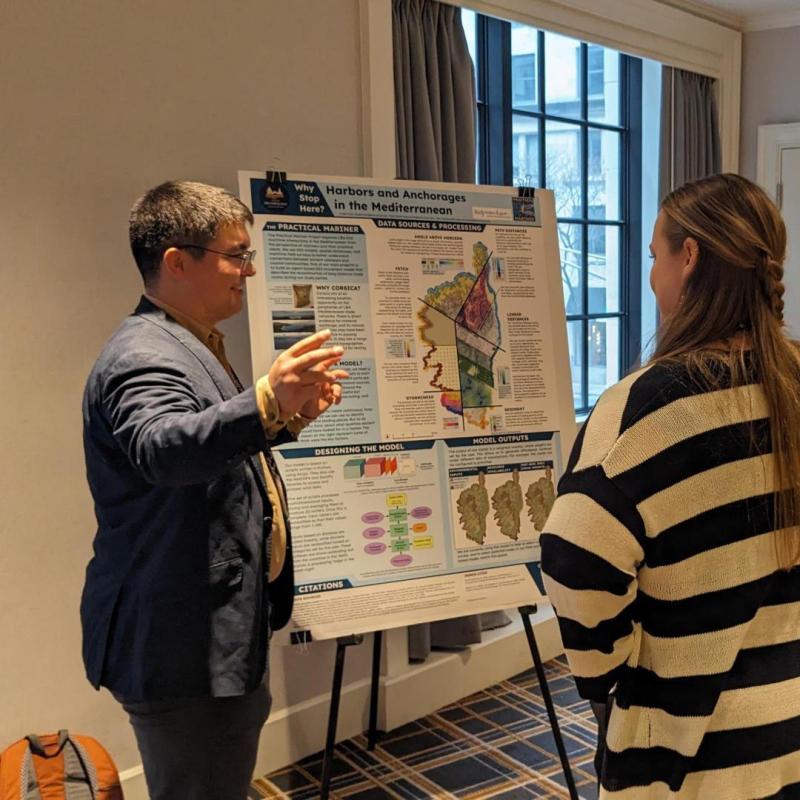
Why Stop Here? Harbours and Anchorages in the Mediterranean
Poster, American Society of Overseas Research Annual Meeting 2025 (ASOR)
Boston, US: November 19-22, 2025

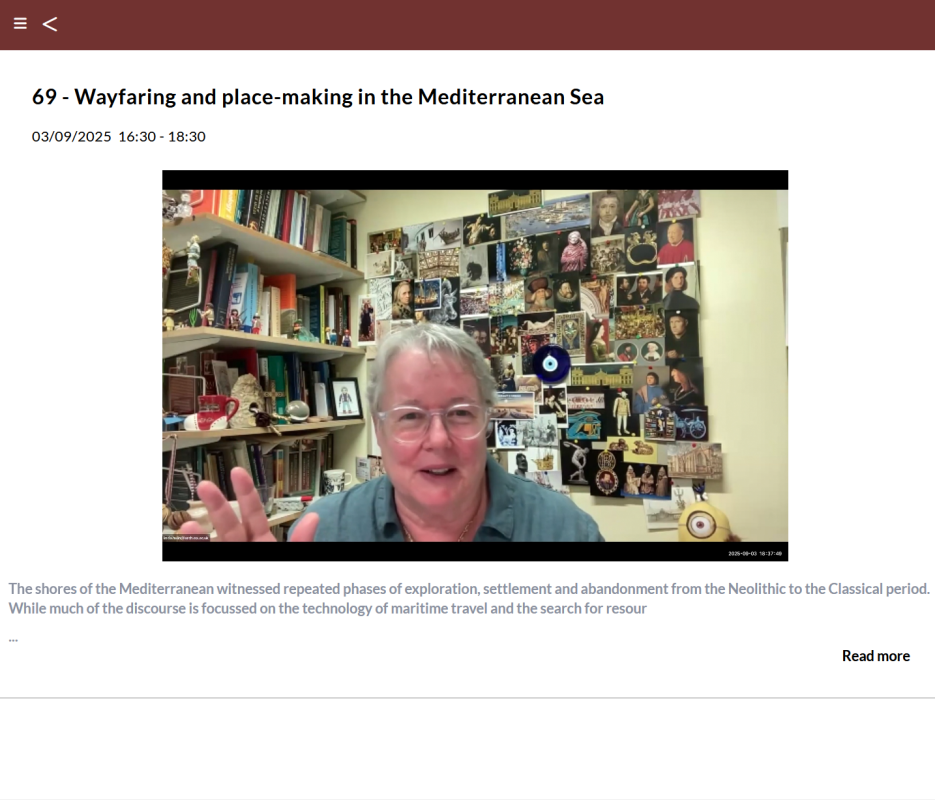
Wayfaring and Place-Making in the Mediterranean Sea
Roundtable, The 31st European Association of Archaeologists Annual Meeting (EAA)
Belgrade, Serbia / Online: September 2-6, 2025

The Practical Mariner Project
Keynote, Graduate Archaeology at Oxford Conference 2025 (GAO)
Oxford, UK: April 25, 2025

Developing a ‘Data-First’ Methodology for Seafaring Modelling
Session / Paper, The 52nd Annual Computer Applications in Archaeology Conference (CAA)
Athens, Greece: May 5-9, 2025

Sourcing Ships from Nut and Acorn to Mast and Gunwale
New Large-Scale Projective Visibility Analyses for the Mediterranean
Papers, The 6th Maritime Archaeology Graduate Symposium (MAGS)
Ioannina, Greece: April 2-5, 2025

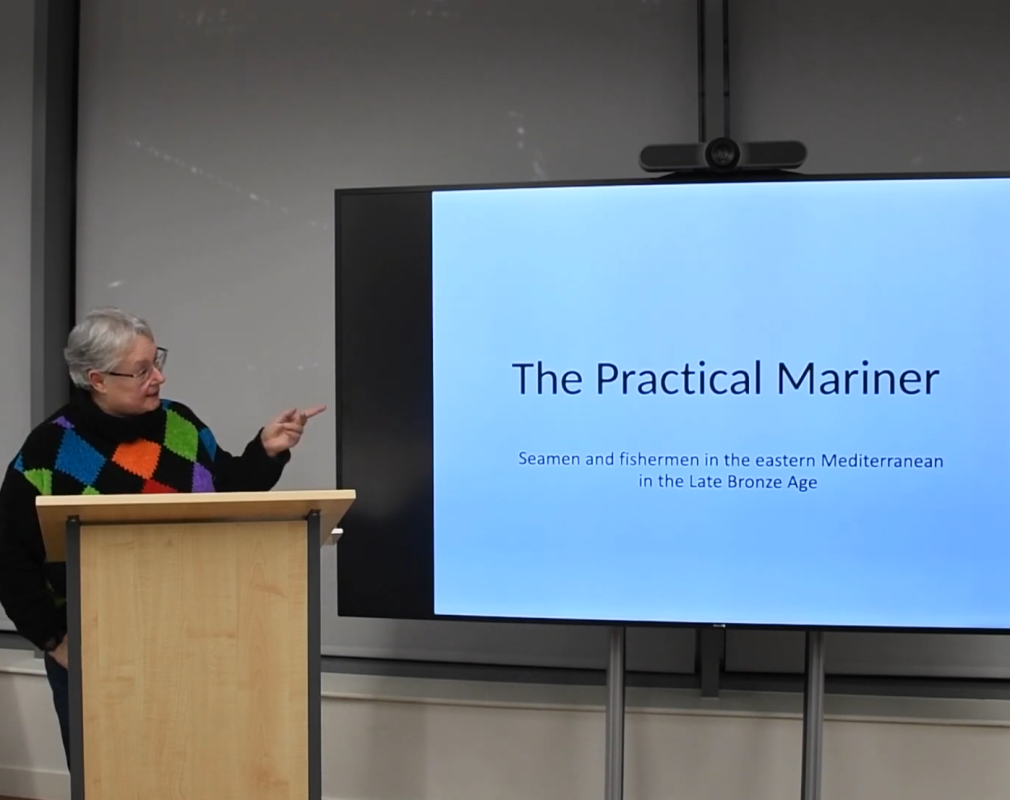
The Practical Mariner: Seamen and fishermen in the eastern Mediterranean in the Late Bronze Age
Public Lecture, Palestine Exploration Fund
London, UK: November 28, 2024
Watch the recordingchevron_right
Unity and Diversity in the Maritime World of the Late Bronze Age Eastern Mediterranean
Paper, 30th European Association of Archaeologists Annual Meeting (EAA)
Rome, Italy: August 28-31, 2024
Research article: Mediterranean maritime visibility: old limits and new approaches
Karl Smith and Linda Hulin
Antiquity, published online by Cambridge University Press: 27 April 2026
Click here to read this article at Cambridge Core
Research article: Sourcing Wood for early Mediterranean Ships in the Late Bronze and Iron Ages
Max K. MacDonald and Linda Hulin
International Journal of Nautical Archaeology, published online by Taylor & Francis: May 11, 2026
Click here to read this article at Taylor and Francis
Book chapter: Across land and sea: shared knowledge and seasonal adaptation in the Late Bronze Age
Linda Hulin
in V. Walker Vadillo and L. Hulin (eds), Temporality, Ecology, and Maritime Societies: The Archaeology of Rhythmic Waterscapes. Bloomsbury Academic: forthcoming.