
New research challenges assumptions about impacts by pre-industrial, small-scale societies on the natural environment in pre-Columbian Caribbean.
A recent study combining radiocarbon dating and stable isotope analysis of pre-Columbian human remains from Guanahaní (San Salvador), The Bahamas, reveals that early island settlers may have significantly depleted local marine resources long before European contact.
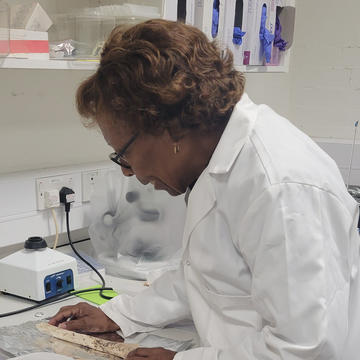
Dr Grace Turner in the Bioarchaeology Lab, School of Archaeology
The research, conducted by an international team, including Professor Rick Schulting and Dr Joanna Ostapkowicz (both School of Archaeology), and Dr Grace Turner (Antiquities, Monuments and Museum Corporation, The Bahamas, and inaugural CaribOx Visiting Fellow) sheds new light on a long-standing debate: whether small-scale, pre-industrial societies could have overexploited their environments.
By analysing carbon and nitrogen isotopes from human remains dated between AD 900 and 1400, the researchers found a marked decline in marine resource use over time. Early settlers relied heavily on high-ranking marine species—such as sea turtles and large reef fish—but as these resources dwindled, communities appear to have shifted toward greater investment in horticulture and other terrestrial food sources.
This research challenges us to acknowledge that pre-industrial communities were not necessarily living in ecological harmony with nature as is sometimes assumed – as with any other species, humans impacted their environments. Nevertheless, the results demonstrate the ability of this early Bahamian population to adapt and reorganize their management of environmental resources.
The findings align with broader patterns observed across the Caribbean, where evidence suggests widespread terrestrial extinctions and environmental change associated with early human settlement. However, this study provides strong supporting evidence for local overexploitation of marine ecosystems in the pre-Columbian era.
Dr Grace Turner: “Palaeontologists recovered remains of a giant tortoise and a crocodile from a blue hole on Abaco Island in 2008. Their research findings surmised that the arrival of humans likely contributed to the extinction of larger animals. This palaeontological research did not include the human element. The current research provides important new evidence on the dynamic interactions of early Bahamians with the natural environment.”
Professor Rick Schulting: “Our results provide a more realistic baseline to think about human impacts on the environment in the past and how they were managed. Humans have always impacted their environment, but then the same could be said about any species. It is a matter of achieving balance, something the ancient inhabitants of The Bahamas managed to do, even if this involved an initial period of adjustment.”
The study offers critical new insights into the long-term human–environment relationship in island ecosystems and highlights the enduring relevance of ancient environmental impacts to modern sustainability discussions.
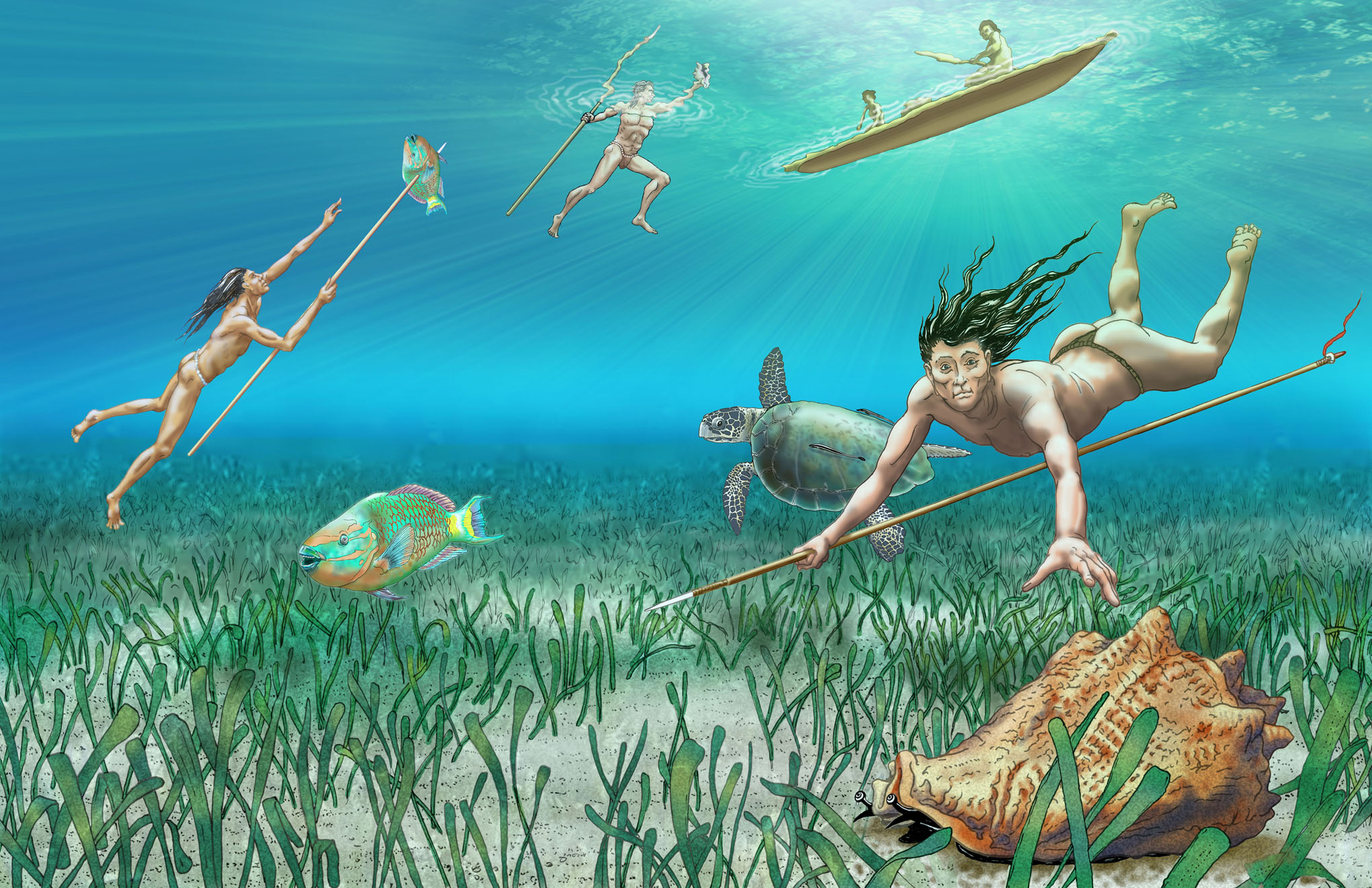
'The Divers' by Merald Clark, for SIBA project

